“Export-quality rose” appears in the description of almost every florist, and almost no one explains what it means. It's not a variety or a brand: it's a quality standard, and yes, you can see it in the bouquet. Here's the real difference, so you know why one bouquet costs three times as much as another that looks similar in a photo.
What “export-quality” means
Colombia is one of the world's largest exporters of cut flowers. For a stem to leave the country, it must meet strict requirements for bud size, stem length and thickness, color uniformity, absence of pests and cutting stage. Whatever doesn't pass that filter stays in the domestic market.
When a florist says it works with export-quality roses, it's saying it buys from that top tier. It's not marketing fluff: it's the same stem that travels to the United States or Europe, except here it arrives in hours instead of days.
The differences you can see
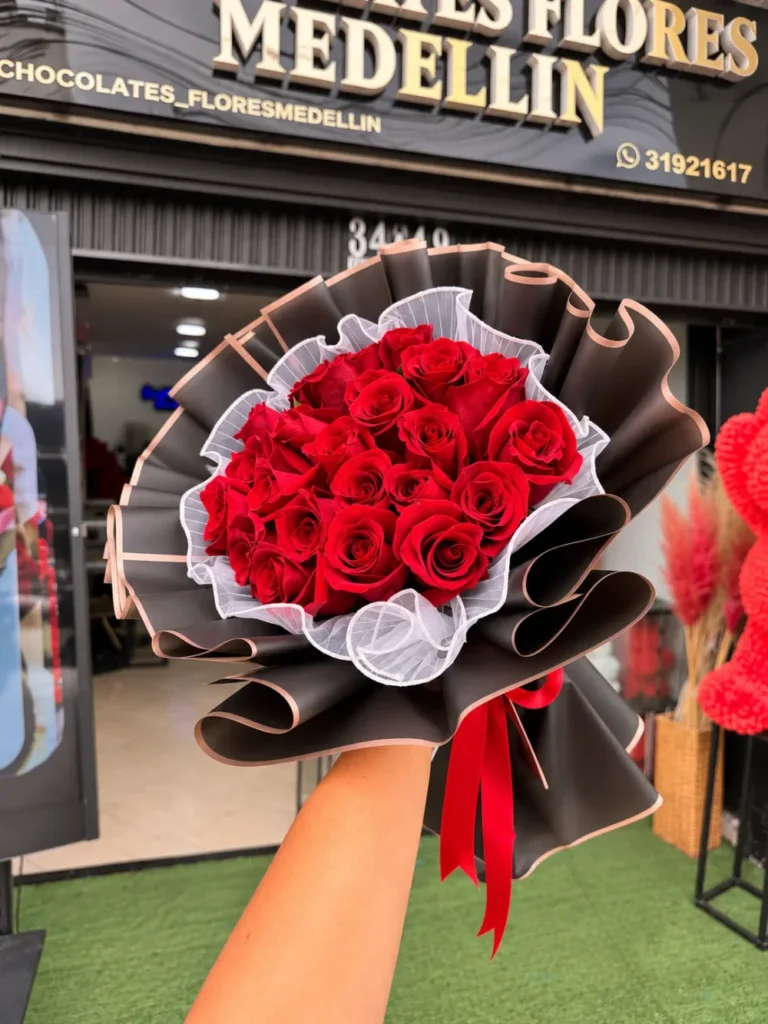
- The bud. Bigger and more compact. It's the first thing you notice: a bouquet of twelve export-quality roses looks like eighteen ordinary ones.
- The stem. Longer and, above all, sturdier. A weak stem makes the flower droop after two days, however pretty it was at first.
- Uniformity. Every rose in the bouquet is the same size and the same shade. A bouquet with uneven buds looks sloppy even if the flowers are healthy.
- The cutting stage. It's cut at just the right moment so it opens in the recipient's home, not before.
How long it lasts, which is what matters most
This is the difference people notice even if they can't explain it. A well-cared-for export-quality rose lasts seven to ten days. A market rose lasts three to five, and often bursts open on the second day and droops its head on the third.
The reason lies in the cold chain and the cutting stage. Export flowers are cut, hydrated and kept refrigerated from the farm; flowers sold in bulk often spend hours in the sun on a truck or at a market. That rough handling doesn't show on day one, but it determines how long they'll last.
If you want to make the most of those days, here we explain how to care for a rose bouquet.
Why Colombia has so many, and such good ones
Altitude and light. The farms on the Bogotá savanna and in Antioquia sit above 2,000 meters, with stable temperatures year-round and a steady twelve hours of daylight. That yields long stems, large buds and production that doesn't depend on seasons, something Europe or North America can only achieve with expensive greenhouses.
For buyers here, the practical upshot is simple: you get top-quality flowers at source prices, without the days in transit that eat up half the flower's life.
When to choose one or the other
- Export-quality when the bouquet is the gift: anniversaries, birthdays, proposals, important thank-yous. Also when it has to travel or wait at a front desk.
- Domestic for decorating a one-day event, for an arrangement that will be taken apart that same night, or for practicing flower arranging.
Put simply: if the flowers will be admired for a week, the price difference pays for itself.
How to recognize it when buying
- Look at the bud in profile: it should look dense and closed, not loose or fanned open.
- Gently squeeze the base of the bud: if it gives like a sponge, the flower is past its prime.
- Check the leaves: firm and green, with no dry edges or spots.
- Look at the stem cut: fresh and clean, not darkened.
- Be wary of prices that don't add up. Top-quality flowers have a source cost no one gives away.
The cutting stage, which decides almost everything
A rose isn't cut when it looks pretty: it's cut when it's at the exact point to open later. Too closed, and it never opens, staying a hard little ball. Too open, and it has two days left.
That point is measured in layers of petals and varies by variety and destination: a rose bound for Europe is cut more closed than one to be sold right here. That's why a rose bought at the farm and another bought at a market can be the same variety and behave completely differently in the vase.
If your bouquet arrives with fairly closed buds, that's a good sign: it means you'll get more days out of the flowers.
What happens to flowers that don't make the cut
They're not bad or spoiled flowers: they have shorter stems, smaller buds or some imperfection in shape or color. They stay in the domestic market, sell for much less and have their uses: decorating a one-day event, arrangements that will be taken apart that night, practice.
Those flowers aren't the problem. The problem is selling them as if they were the others, which is what happens when you see a bouquet of twenty-four roses at a price that doesn't add up.
Colors and varieties
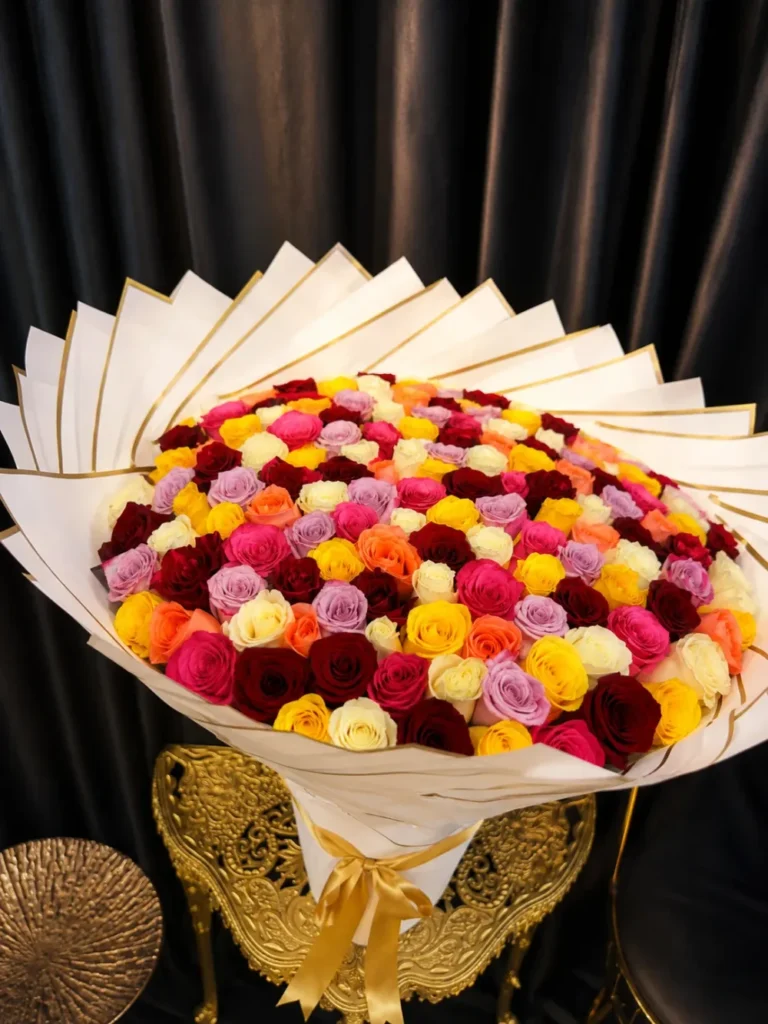
Within export-quality roses there are dozens of varieties, and each color usually comes from one or two specific ones. That explains something that confuses many people: two “red” bouquets from different florists may not be the same red or have the same bud size.
It also explains why a color is sometimes unavailable: it's not that the color sold out, it's that there was no harvest of that variety that week. When that happens, we let you know and suggest the closest equivalent before putting anything together.
Frequently asked questions
Is the export-quality rose a different variety?
No. It's a quality classification. Within it there are many varieties, each with its own color and bud size.
Does it smell less than a garden rose?
Yes, generally. Commercial varieties are selected for size, color and vase life, and fragrance is usually what gets sacrificed. A garden rose smells stronger and lasts much less.
Are dyed roses export-quality too?
Those with applied color, like the blue rose, start from white export-quality roses: you need a top-grade petal for the color to take evenly.
How much more does it cost?
It depends on the season, but it can double or triple the price per stem. In the finished bouquet the difference shrinks, because the packaging and labor cost the same.
All the rose and chocolate bouquets in our shop are made with export-quality roses. See the export-quality rose bouquet.